Warren's Fair Share Plan puts about 376 units on three sites, not about 1,200
The Planning Board adopted the Housing Element and Fair Share Plan 7-0 on June 25, 2025. Three sites carry roughly 376 total units at about a 40 percent affordable proportion. A conventional set aside would have required roughly 1,200.
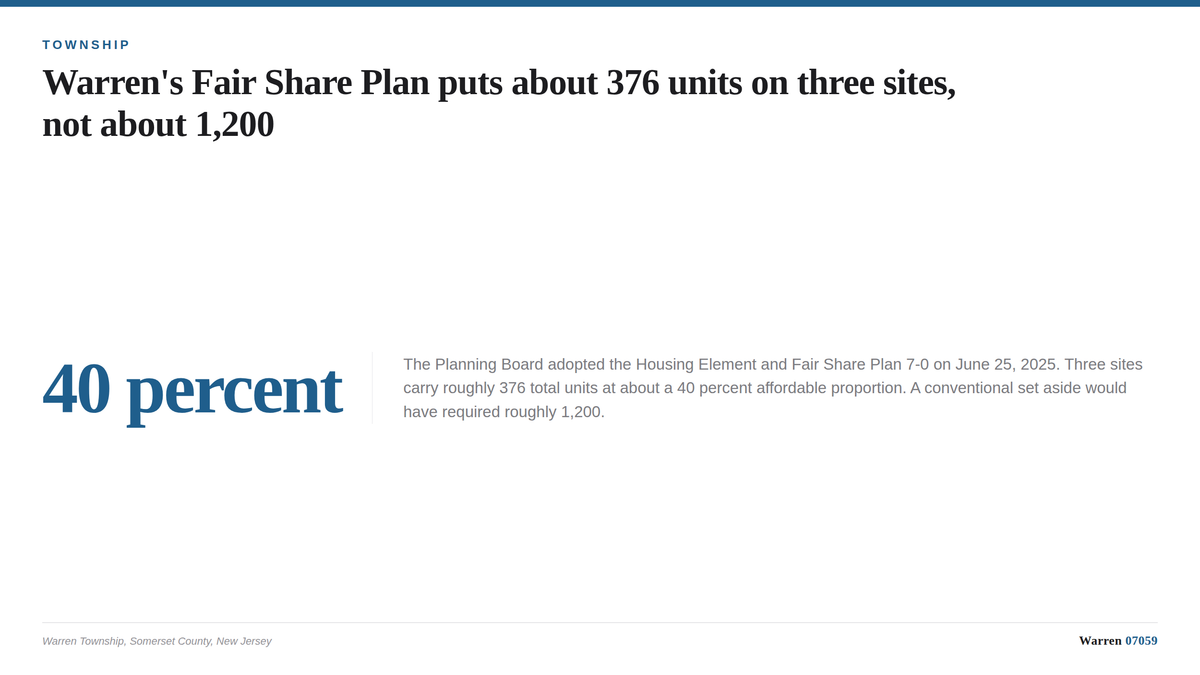
On June 25, 2025 the Warren Township Planning Board held the statutory public hearing and adopted a resolution approving the Master Plan Housing Element and Fair Share Plan on a 7-0 roll call. The plan addresses a court ordered obligation of 262 units using three sites that produce approximately 376 total units, affordable plus market, at about a 40 percent affordable proportion. The planners told the Board that meeting the same obligation with a conventional 15 to 20 percent set aside would have required roughly 1,200 total units. The Township Committee endorsed the plan the following night by Resolution 2025-144, 3-0.
The number most residents will hear about this plan is 262, the units a court ordered Warren to plan for. The number that actually determines how much gets built is 376. Understanding the difference between those two figures, and why 376 is not 1,200, is the whole point of this plan.
The vote
The Planning Board met in special session on June 25, 2025, held the statutory public hearing, and adopted the resolution approving the Master Plan Housing Element and Fair Share Plan. The motion came from Mr. Esposito and was seconded by Mr. DiBianca.
Voting in favor: Mayor Lontai, Lindner, Puglisi, DiBianca, Esposito, Scuderi and Lippitt. None against. The roll was 7-0.
Attorney William Willard, Planner John T. Chadwick IV and co-planner Katherine Sarmad presented the plan to the Board.
The design point worth understanding
An affordable housing obligation is satisfied in affordable units. Market rate units are the byproduct of how a town chooses to produce them.
A conventional inclusionary project sets aside 15 to 20 percent of its units as affordable. At that ratio, every affordable unit drags four or five market units along with it. The planners told the Board that meeting Warren's obligation that way would have required roughly 1,200 total units.
Warren's plan instead pushes the set aside higher, to 25 and 31 percent on the two inclusionary sites, and adds one development that is 100 percent affordable. The result is approximately 376 total units at about a 40 percent affordable proportion.
That is the trade. A higher affordable percentage per project means far fewer total units, and far less market rate construction, for the same obligation.
The three sites
| Site | Total units | Set aside | Affordable units |
|---|---|---|---|
| Chase property, King George Road, previously approved for a hotel | 140 | 25% | 35 age restricted |
| Toll Brothers or Broda property, for sale units | 176 | 31% | 55 |
| Mountain Boulevard redevelopment, 100 percent affordable | 60 | 100% | 60 |
The Toll Brothers site carries two commitments beyond housing. The Board was told it is expected to yield a minimum of about 30 acres of open space to the township and to contribute toward sewer.
The Mountain Boulevard redevelopment generates 60 credits plus 58 bonus credits, 118 credits in all. Bonus credits may supply up to 25 percent of the total obligation.
How the 262 is accounted for
The plan addresses the court ordered 262 units by counting 47 existing units, 22 surplus credits and 16 bonus credits, leaving roughly 150 to be satisfied by new projects. The three sites produce 150 affordable units.
Those three credit categories add to 85. I am reporting the residual as the record states it rather than deriving my own figure from the components, and I have not reconciled the two.
Why Warren's obligation is as large as it is
Planner Chadwick made a point at the March 31 special meeting that explains more about this process than any other single fact. Warren's median household income is roughly triple the New Jersey average, and that drives its affordable housing allocation upward.
The state's methodology assigns obligations partly on capacity. A town with high income and high property values gets a larger number than a town without them. Warren's 262 is a function of what Warren is, not of anything the township did or failed to do.
The survey behind the plan
The Planning Board opened the Master Plan process at a special meeting on March 31, 2025, targeting a draft by May 30 and completion by June 30. Chairman Lindner acknowledged at the time that the schedule was tight.
The community survey drew about 290 paper responses and about 563 electronic responses, roughly 853 in total, out of about 5,000 households.
The top ranked resident priorities were preservation of open space, controlling housing and development, traffic and infrastructure, and revitalizing Town Center. Board members also noted that the survey showed residents favored higher density along Route 78.
The Committee endorsement
The Township Committee took the plan up on June 26. With Blick and Croson absent and excused, Resolution 2025-144 passed 3-0 on the votes of Fine, Kian and Lontai.
The resolution reserves the township's right to amend the plan if final adjudication or settlement comes in below 262 units, and it directs the Attorney to file the plan with the Affordable Housing Program as part of the pending Declaratory Judgment action under AOC Directive 14-24. The Planning Board made the same reservation in its own resolution.
The plan was to be filed with the court within 48 hours of adoption.
Committeeman Fine said he was proud of all of the efforts and the final plan.
A bond ordinance lesson, courtesy of Maxwell Court
The same June 26 meeting produced a small procedural lesson worth keeping.
Ordinance 25-13, a $150,000 bond ordinance for Maxwell Court drainage, could not be adopted that night. Willard explained that a bond ordinance requires an affirmative vote of two thirds of the entire governing body, which on a five member Township Committee means four members. Only three were present.
An ordinary ordinance passes on a majority of those present. A bond ordinance does not. That distinction is why two absences can stop borrowing but not zoning.
Update, July 2: the hearing was carried to a special meeting on July 2 at 5:30 p.m., where the ordinance passed 4-0. Resolution 2025-182 awarded the engineering to Remington and Vernick the same night.
Block and lot numbers for the three sites, the identity of the Mountain Boulevard redeveloper, and the dollar value of the Remington and Vernick engineering contract are not in the record I worked from. I have not estimated any of them. If you want to know whether a specific parcel is involved, read the adopted plan rather than this summary.
- Warren Township Planning Board, Special Meeting Minutes, June 25, 2025. https://www.warrennj.org/AgendaCenter/ViewFile/Minutes/_06252025-880
- Township of Warren, Township Committee Minutes and Resolution 2025-144, June 26, 2025. https://www.warrennj.org/AgendaCenter/ViewFile/Minutes/_06262025-882
- Township of Warren, Township Committee Special Meeting Minutes, July 2, 2025. https://www.warrennj.org/AgendaCenter/ViewFile/Minutes/_07022025-886
- Warren Township Planning Board, Special Meeting Minutes, March 31, 2025. https://www.warrennj.org/AgendaCenter/ViewFile/Minutes/_03312025-848